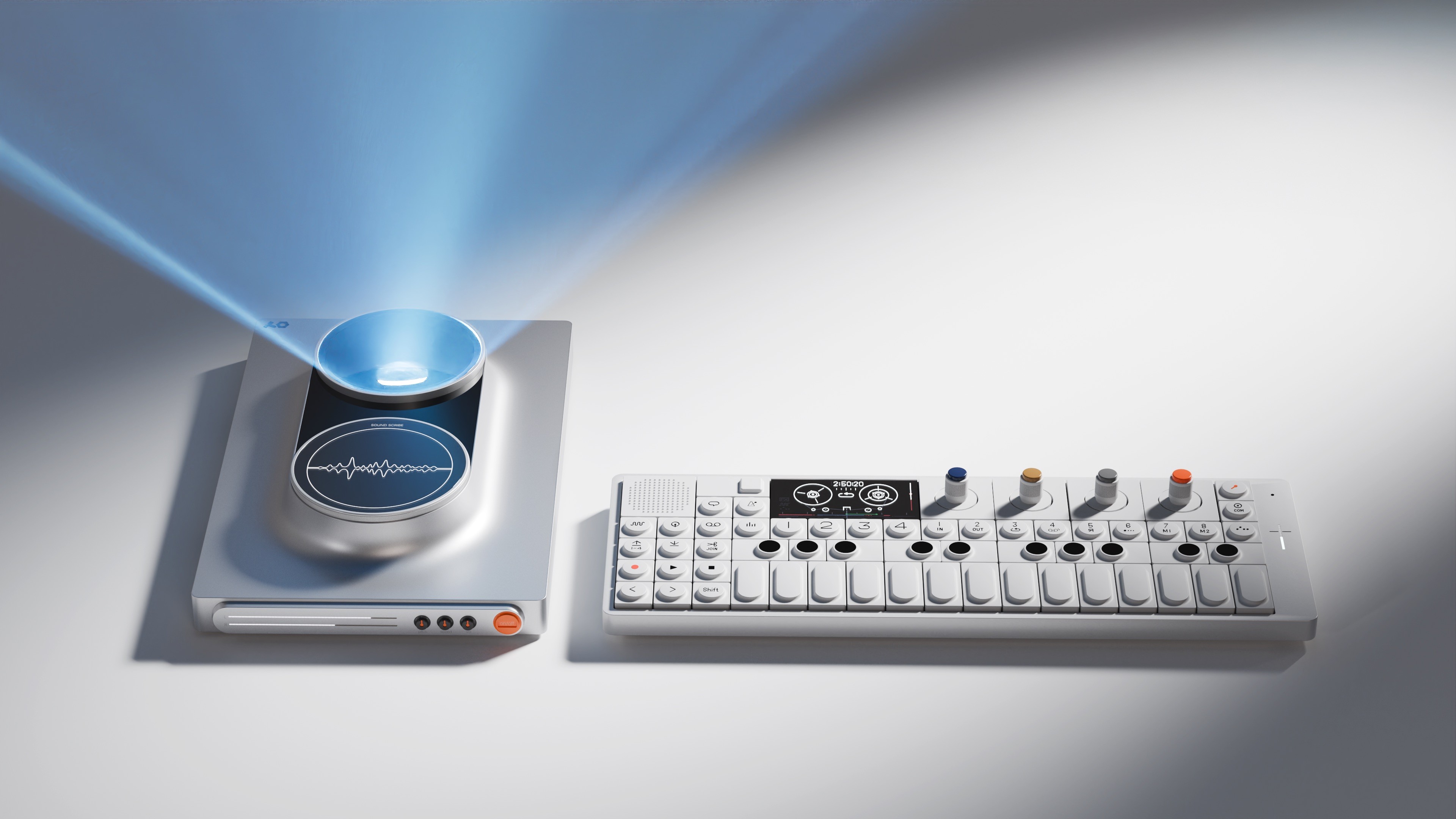
Synesthesia Machine
A record player that shows you what your music looks like.
Sound synesthesia is a rare condition where people see color and shape when they hear sound. The Synesthesia Machine builds a version of that into a turntable. As a record plays, an AI model interprets the music and a built-in projector fills the room with visuals, all run from a single dial. It builds on Modem Works and Teenage Engineering’s OP–Z project and is designed in Teenage Engineering’s language.

[01]
The idea
Some people hear music in color. The Synesthesia Machine lets everyone else see it too.
Sound synesthesia
AI-generated visuals
Built around vinyl
[Sound synesthesia]
Auditory sense
Abstract sight
A rare neurological condition. People who have it experience sound through another sense, often seeing abstract colors or shapes when they hear music.
Sound
Played from a record on the platter
AI
Interprets the music as it plays
Light
Projected into the room in real time
1 dial
Runs the projector and the visuals
[02]
Background
Inspired by a rare condition and a playful OP–Z experiment from 2022.
Neuroscience
Inspiration
Brand study
The condition
Rare neurological condition
Sound seen as color and shape
Felt through another sense
The OP–Z project
OP–Z synth extension
Music into live AI imagery
Then into generated video
The brands
Teenage Engineering’s style
Modem Works’ research
Form, CMF and interface
[02.1]
The OP–Z project
The two studios turned the OP–Z synthesizer into a live AI image generator. The Synesthesia Machine takes that idea off the desk and into the living room.
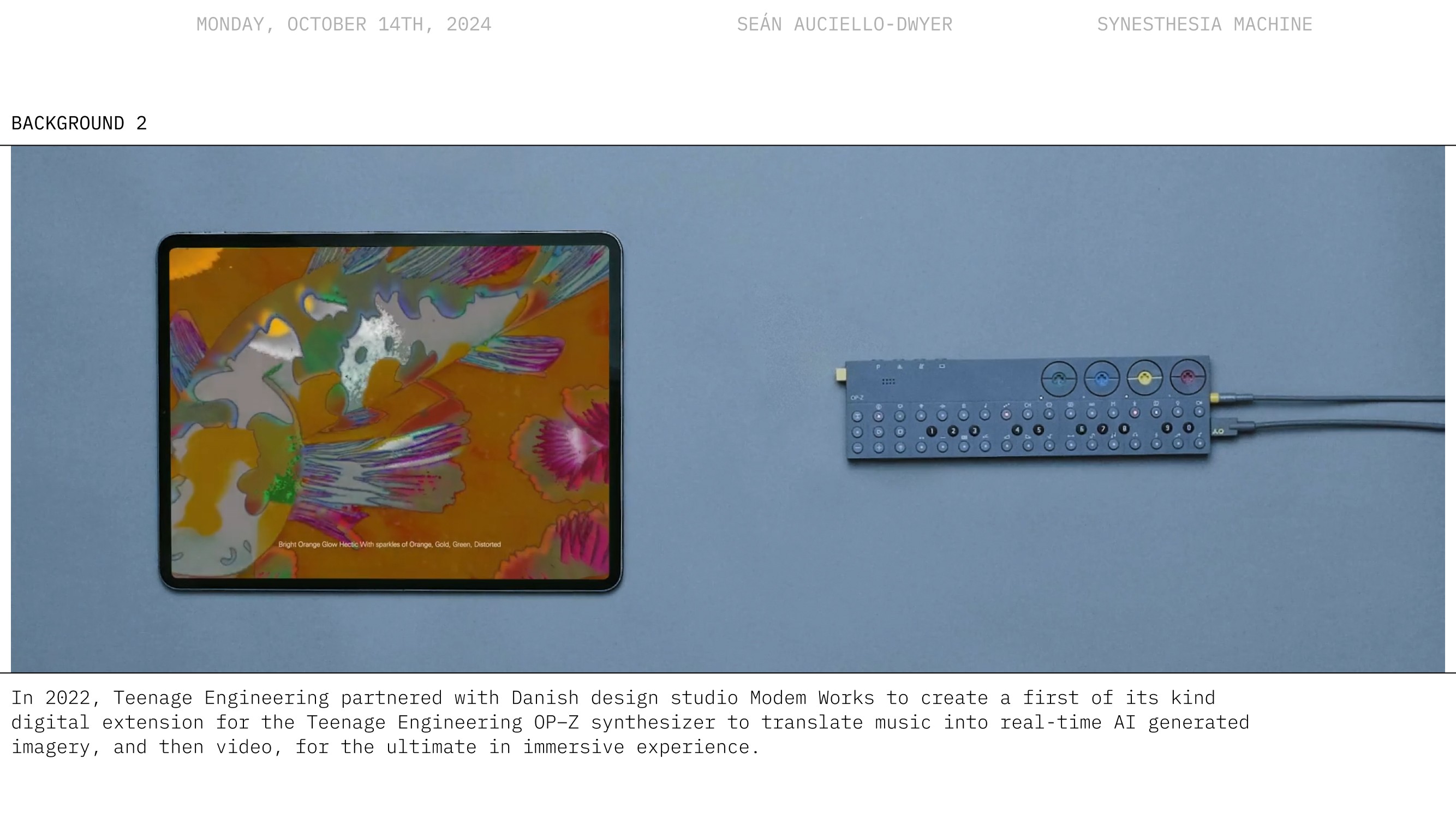
OP–Z visualizer
[2022]
Teenage Engineering
Modem Works
OP–Z synth
Real-time AI
Generated video
[The studios]
The two studios behind it
Teenage Engineering
Origin
Swedish electronics company, founded 2005
Known for
The OP–1 synthesizer
Modem Works
Origin
Amsterdam design studio
Has worked with
Harvard GSD and OpenAI
[03]
Design language
Teenage Engineering pairs serious engineering with a sense of play.
Modular
Streamlined
Precision
Playful technic
Modern retro

Modular

Precision

Streamlined

Playful Technic


Modern Retro
[Teenage Engineering: modular, streamlined, playful technic, precision, modern retro]


[Modem Works: creative design meets emerging technology]
A record player that could sit in Teenage Engineering’s lineup.
[04]
Who it’s for
People who collect beautifully made, slightly nostalgic things and still want new experiences at home.
Creative and artistic
Tech-savvy


[The user]
Values design and function equally
Creative, artistic and tech-savvy. The objects around them have to look good and work just as well.
Curates their space
Their home says who they are, and it’s set up to inspire creativity and relaxation.
Crafted objects
Beautifully made things earn a place in their home.
Clean metal shell
Nostalgic feel
Analog rituals like dropping the needle still matter.
Vinyl stays at the center
Sensory first
They want experiences, not just more devices.
Light that fills the room
Design and function
It has to look good and work just as well.
One dial runs it all
Calm spaces
Home is for creativity and relaxation.
Visuals on the walls, not a screen
[05]
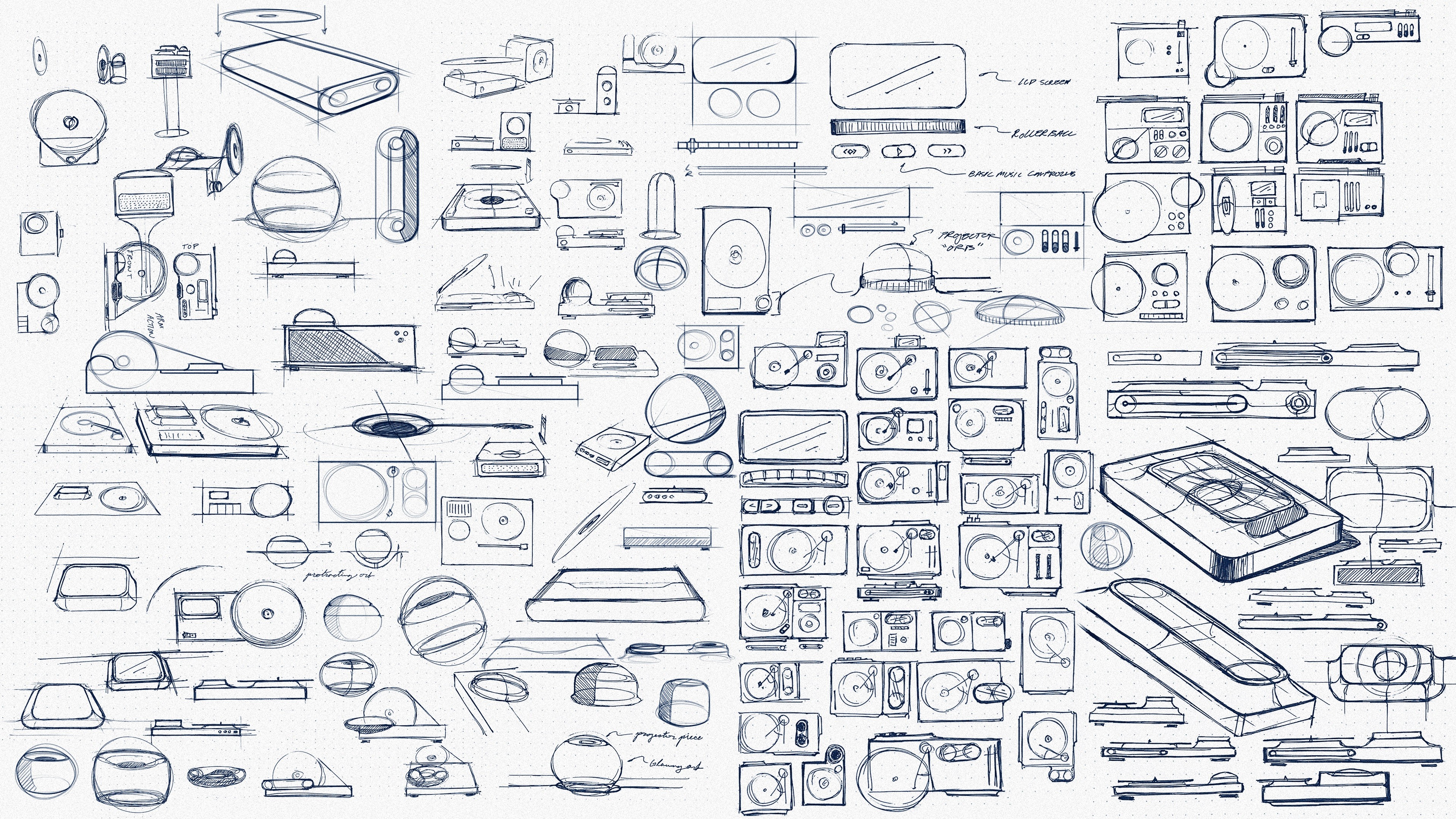
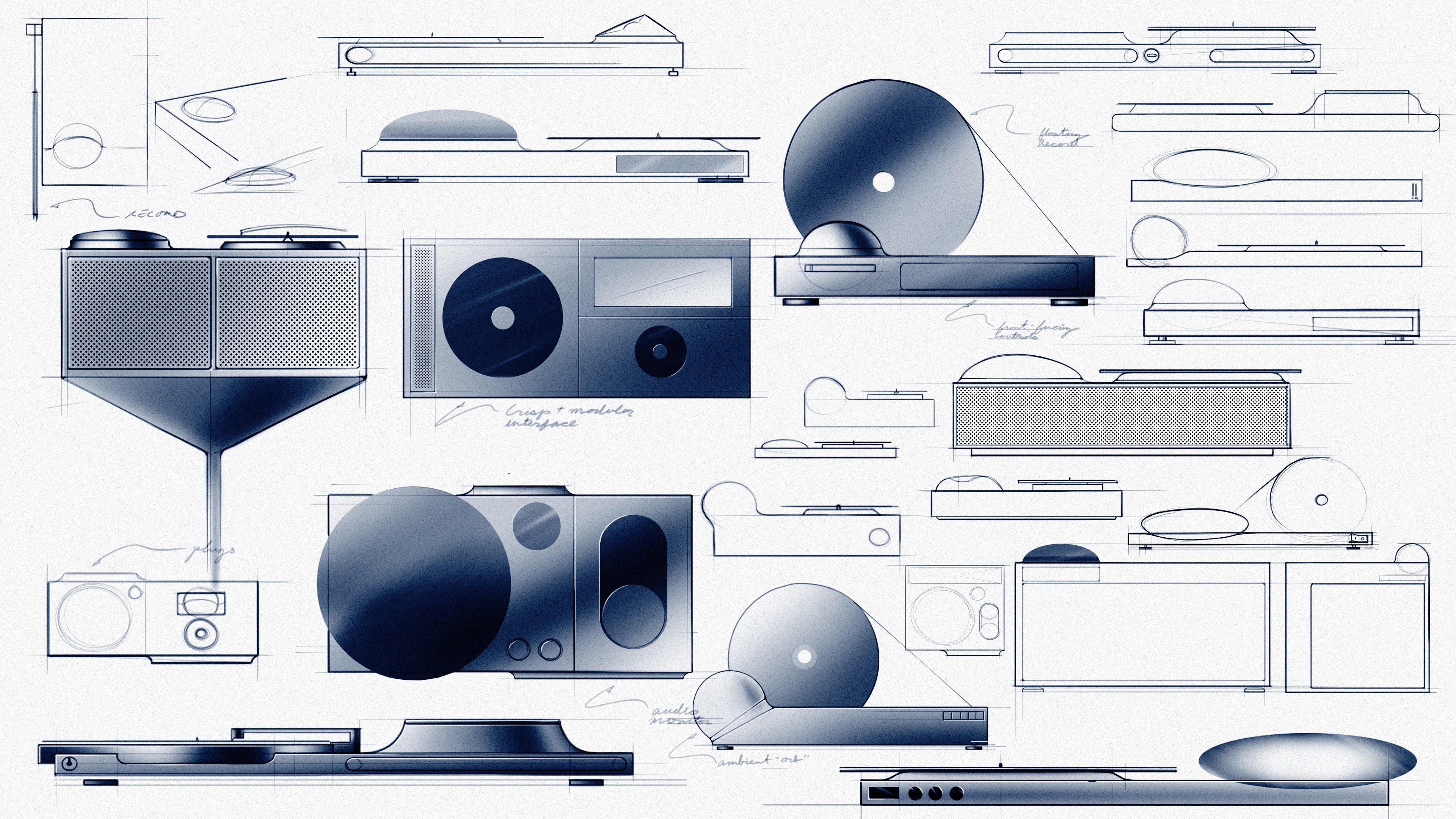
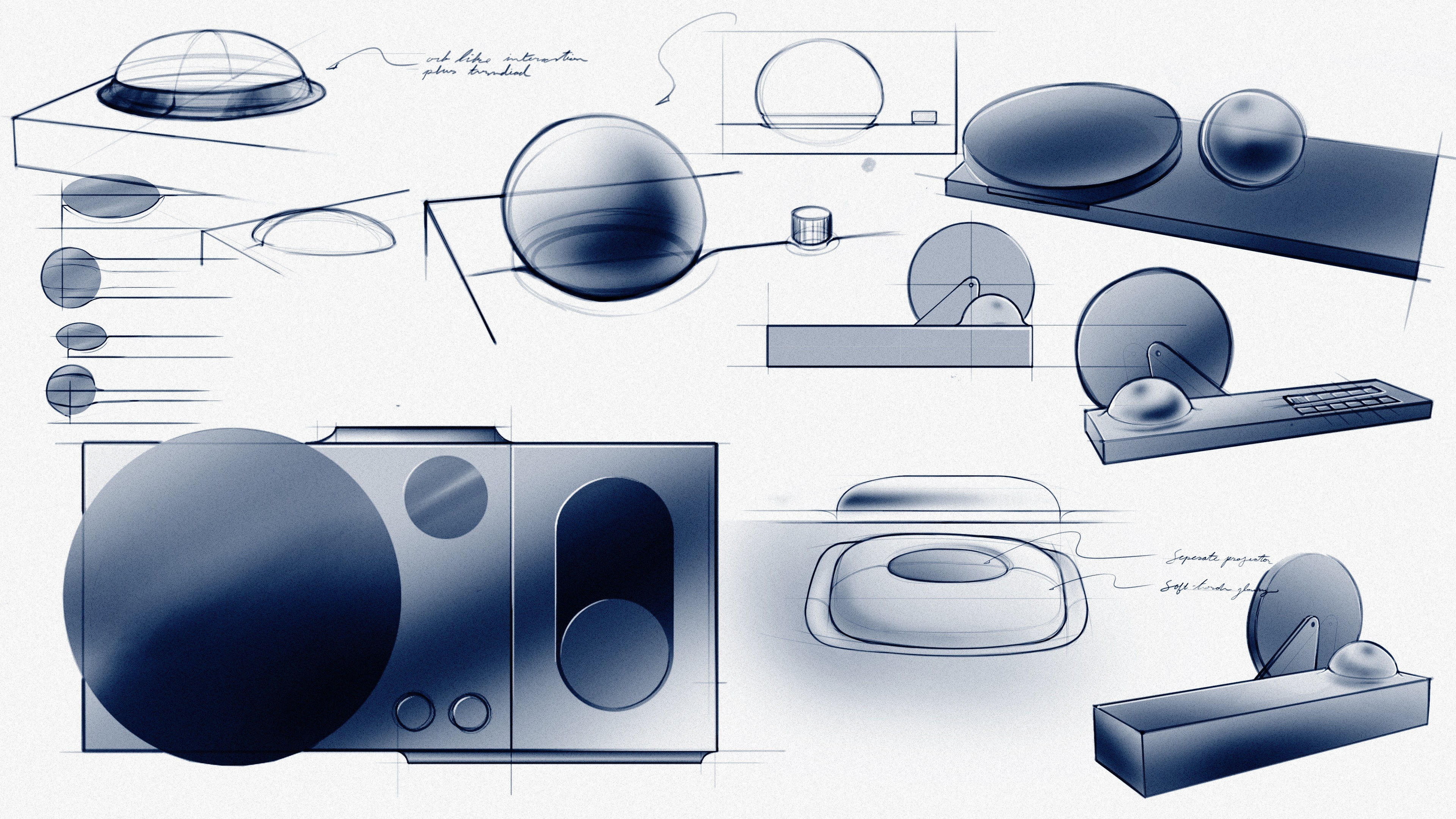
Ideation
Pages of exploratory thumbnails, refined into smarter concepts.
Thumbnail forms
Explore the projector
Render the strongest
[06]
Prototyping
Simple printed blockouts showed how the forms and proportions really sit in three dimensions.
Sketch
Print blockouts
Compare proportions
Refine

Printed while sketching
Blockout models were printed during and after the sketching process, not saved for the end.
Proportion in hand
Holding the forms made it clear how the platter, tonearm and projector share one footprint.
Two plates, one object
The direction that stuck put the turntable and the projector on two plates that read as one object.
[07]
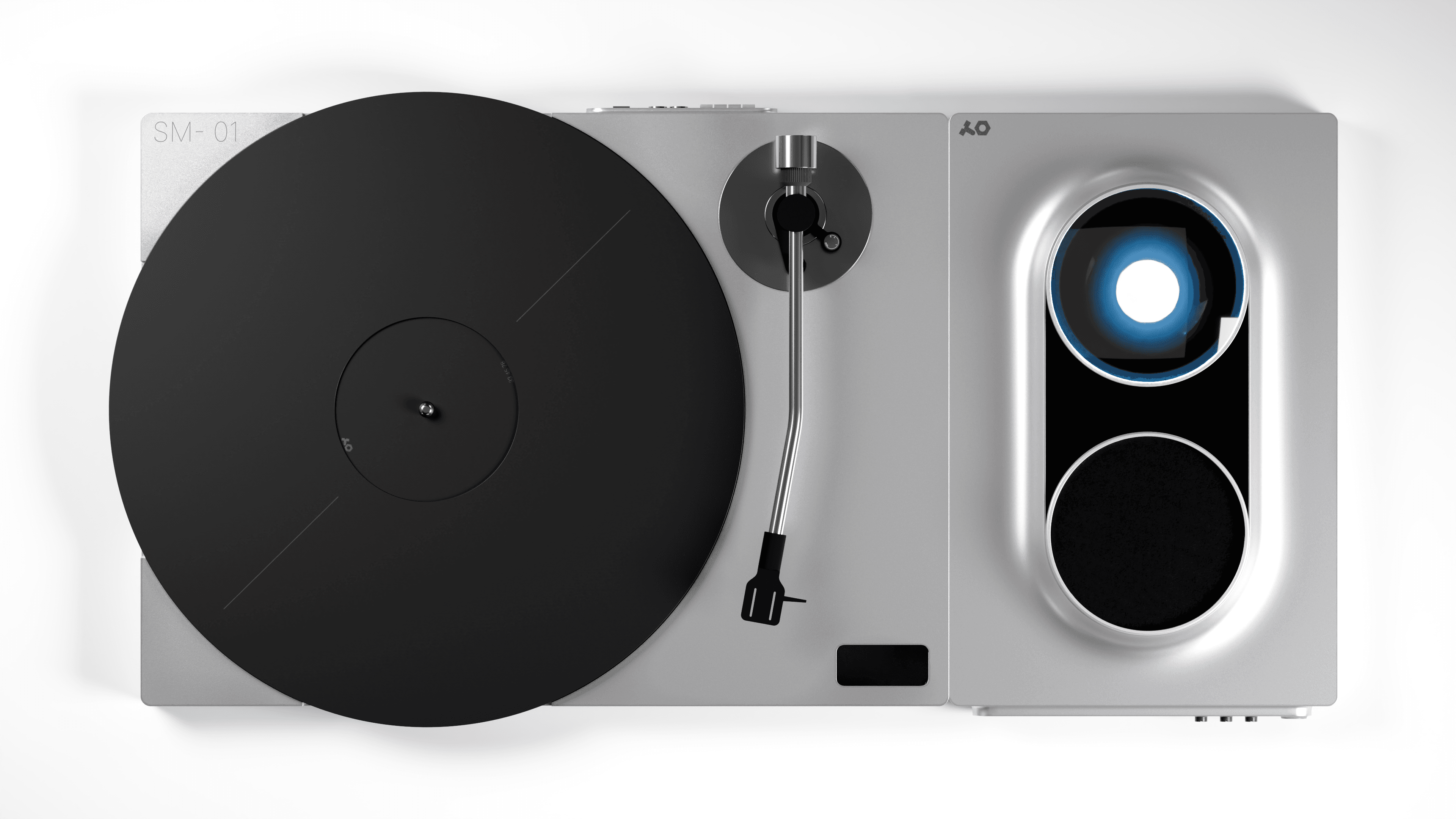
Layout
The turntable gets one plate. The projector and the dial get the other.
[08]
Interface
Mapping the digital user flow and the physical user interface.

[Fig.] Dial menu: the projector path (contrast, focus) and the visualizer path (model type, Sound Scribe)

[Fig.] Turntable control strip: level meters, speed, pitch, volume and on/off
[09]
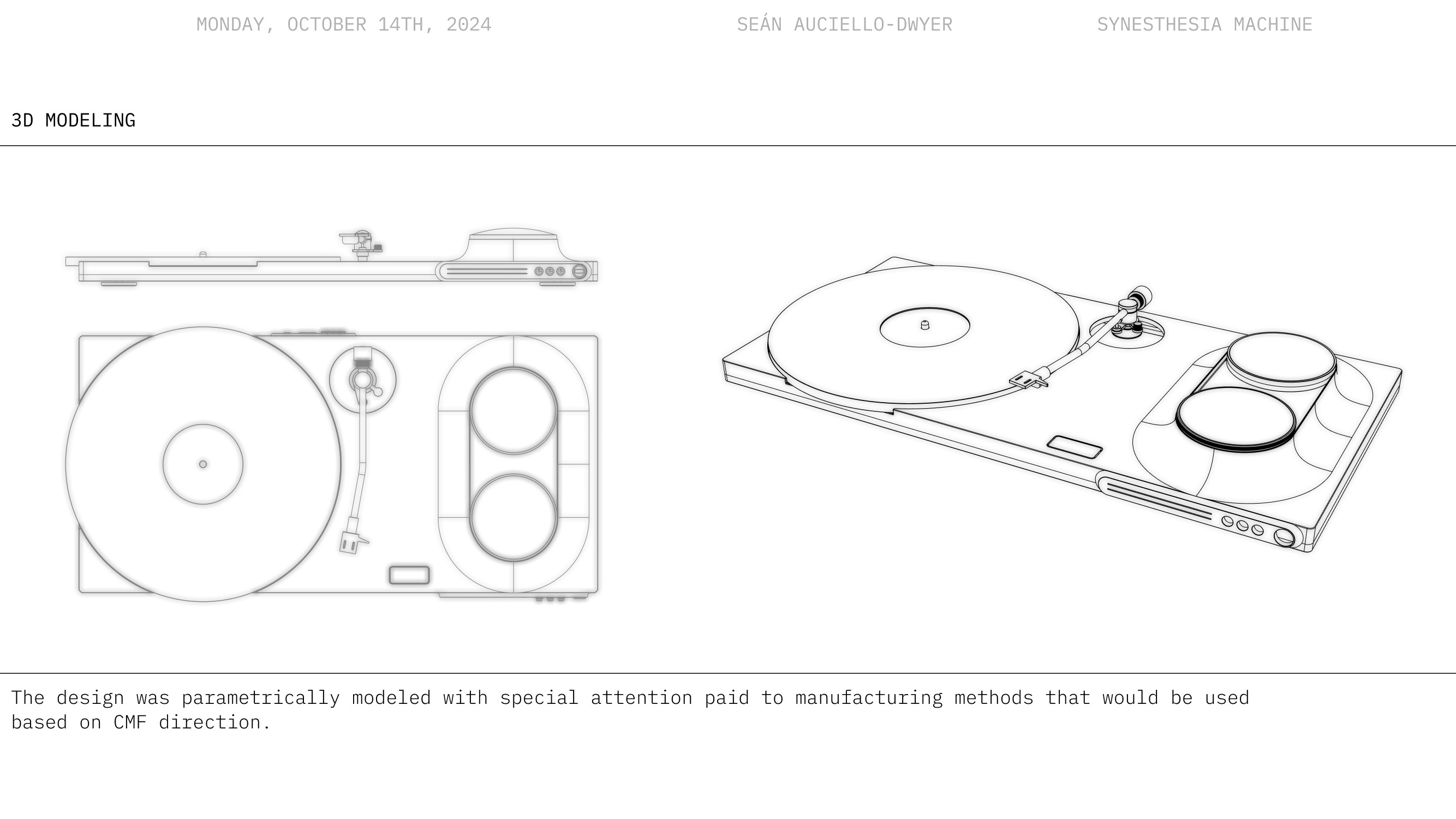
CAD
Modeled parametrically, with the manufacturing method behind each material in mind.
Parametric model driven by CMF
[10]
Final renders